Thursday, February 3, 2011

Credit card usage in four countries

"Credit Card" is a kind of short term loans. Consumer pays for the good/service with a credit card. In effect, the bank loans the money to the consumer. Each month the bank presents a bill to the customer, and then the customer has a grace period of normally 3 weeks non-interest time to settle the bill. Usually the bank will also award the customer with "loyalty points", which can be used to redeem for gifts. The customer has the payment convenient, non-interest loan, and bonus points. The bank charges the shops a commission for providing this payment service. Shop owners can tap into mass credit card holders by accepting this mode of payment. It seems like a 3-way win-win-win situation. That's why VISA and Mastercard are so profitable today.

But if you look into more details of this credit card payment method, you will find something big. The commission rate is about 2 to 2.25% of the sales. For a $20 sale, the charge is 40 cents. If a shop passes this 40 cents surcharge to customers when they use credit cards, not cash, it would be an enough discouragement to use cards. Thus, credit card issuers do not allow it to happen. They demand the shops, who accept credit cards, can not charge differently whether the customers pay with cash or card. Shops have to increase the prices to mark up the card commissions. In this way, an article on a newspaper said, card holders are taking advantage of non-card holders.

Big department shops can absorb this 2% charge easily. However, most small shops, which are on low profit margins, think 2% is unbearable. So they do not accept credit card payment method at all. Fortunately, there is also a debit-card market, which is much cheaper comparing to credit card, provides cashless payment convenience. This is exactly the situation in Singapore.

In Australia, the central bank allows the shops to pass the extra cost to consumers. Not long ago, I read an article on the internet. The amount paid with credit cards was becoming lower and lower. The sales paid with debit card surpassed credit cards.

In Canada I am using credit card to build my credit history. If my credit report has a wonderful score, it will save me thousands of dollars when I take up a mortgage in the future. Back in China, I once did have a credit card. But in fact I never used it before I put money into the account. So it was more like a debt card.

Wednesday, February 2, 2011

To experience is to believe

I'm lucky to be able to reside in four countries: China, Singapore, Australia, and Canada. China is my home country. I left it when I was in my late 20's. I only knew deposits at that time. And I did not have a sense to different interest rates. In 1996 one year bank deposit could bear a double-digit interest rate. That was a hype-inflation period. My savings was mostly in 1 year term deposit, and renewed year after year, since I did not know other options.

I am amazed to read my old blog posts of 2005 and 2006. I know that my financial knowledge was much expanded during that time. I was hunting for higher saving interest rate, I got used to online banking accounts (only operated via internet or telephone), I opened a foreign exchange broker account, and I did online stock trading as well. The most distinguished feature of Singapore financial market is that, the government controls inflation through currency exchange rate, not common "overnight interest rate".

Australia is a special market too. At present, all major developed countries have a super low interest rates environment. But the Aussie overnight interest rate is 4.75% (Japan 0.1%, US 0.25%, Canada 1%, Euro 1%). This is really a question to me. How does Aussie dollar to run under so high rate?

After coming to Canada, I'm surprised to find so many small "banks". Not only to mention "ING Direct" and many many credit unions, I find that there are a lot of corporations, whose core business is others, are offering banking deposits, i.e. Ally, Canadian Tire Bank, etc. The only common thing among them is that they participate in a deposit insurance. This situation will definitely not happen in China where creditibility is much hard to gain.

New post after almost five years

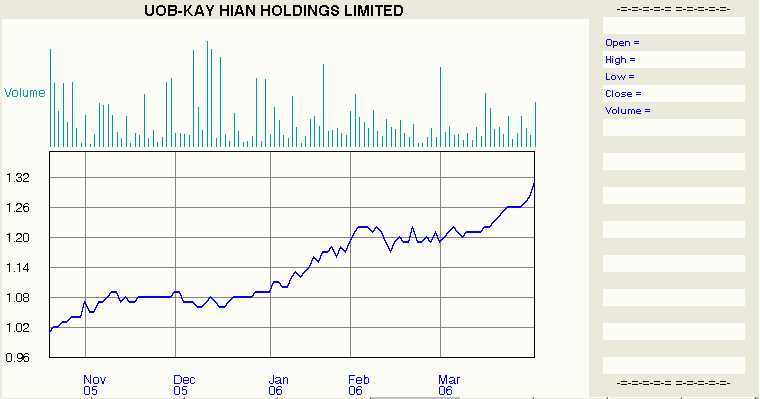
It's been nearly 5 years since the last post. My life has had a lot of changes during this period. Yet the stocking market continues. In the last post UOB KeyHian was at $1.31. Today it is $1.81. Also count its dividends in these five years time.

The last five years are important to stock investors. We encountered "big bull" in 2007, "great financial crisis" in 2008, "massive quantitative easing" since 2009 till today and possible to 2012. Let me calculate the return rate of UOB KH:

Dividends: 2007: 0.195, 2008: 0.124, 2009: 0.075, 2010: 0.08.
Price gain: 0.50.
Return rate = (0.195 + 0.124 + 0.075 + 0.08 + 0.50) / 1.31 = 74%

I think an annual return rate of about 14.8% is satisfactory in this example.

Thursday, March 30, 2006

Monday, March 20, 2006

UOB KAYHIAN


Slowly but steady. Its price is reaching 52-week high. I like its pattern.

Tuesday, March 14, 2006

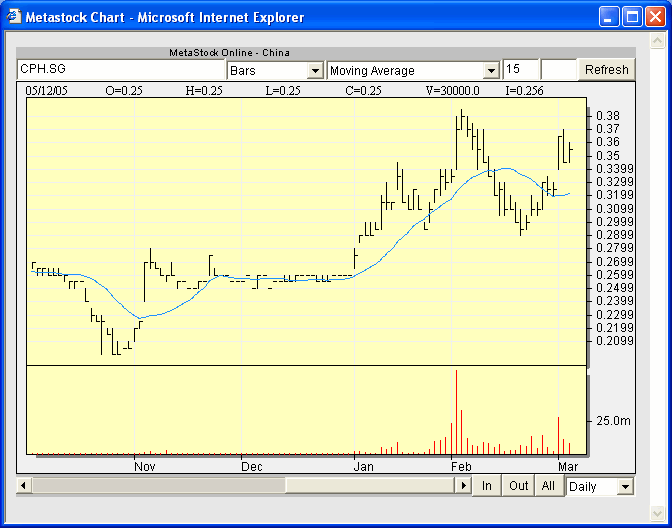
CPH 4th review


Despite good results and dividends, its price is dropping...

Sunday, March 5, 2006

China Paper third visit


Its price has recovered since it announced revenue and net profit jump, and a dividend of RMB 0.111. Better than I anticipated.